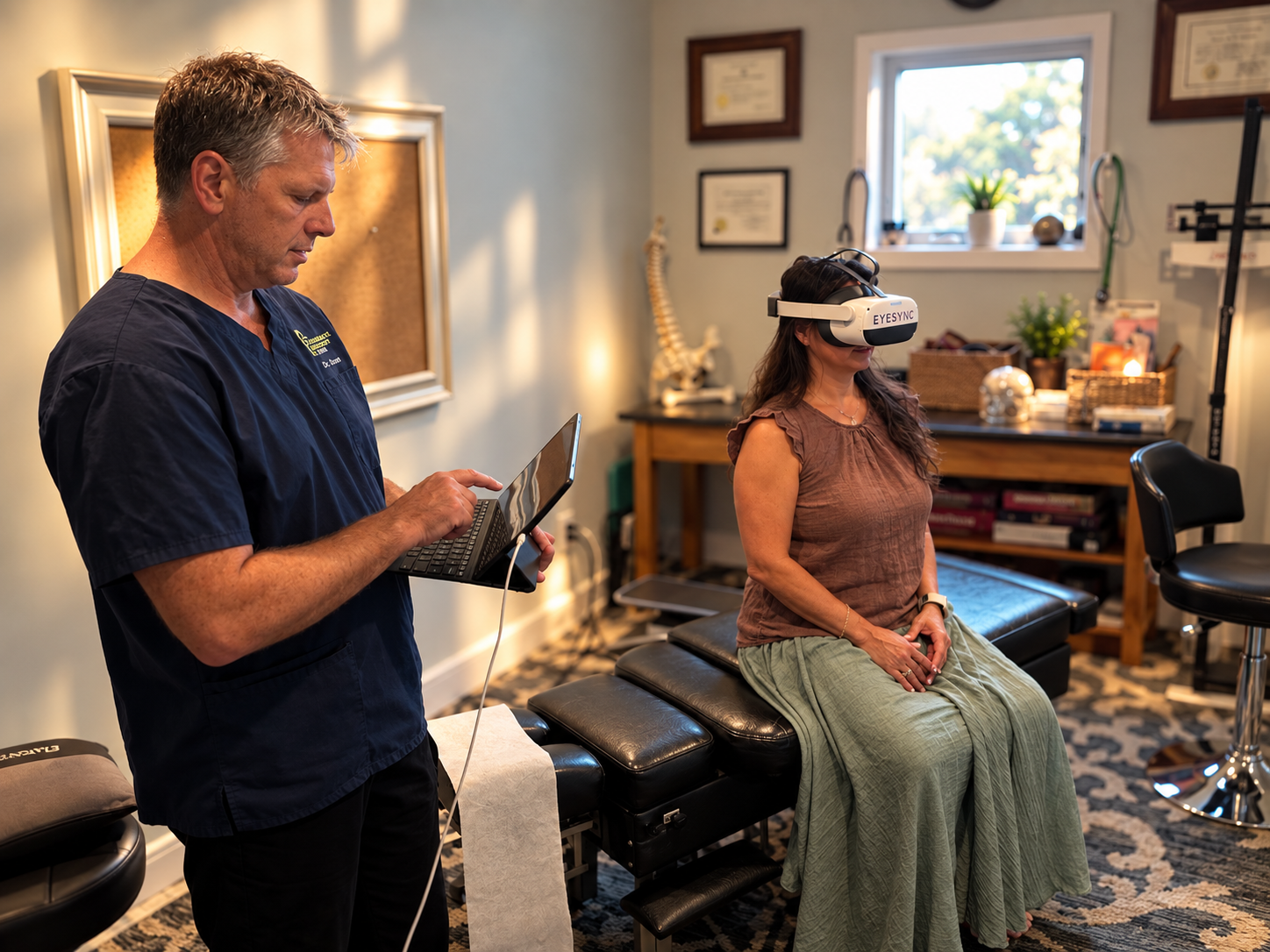
Vestibular testing helps evaluate the systems involved in balance, spatial orientation,
and keeping vision stable while the head and body move. At Chiropractic Neurology Center
in Long Beach, vestibular testing may be included as part of an individualized
neurologic and chiropractic evaluation when appropriate.
Dr. Shad Groves conducting vestibular testing with an eye-tracking headset at Chiropractic Neurology Center.
What is the vestibular system?
Your sense of balance depends on several systems working together. The vestibular
system in the inner ear detects head movement and position. Your eyes provide visual
information, while muscles and joints provide information about where your body is
in space. The brain combines these signals to help you remain upright, move safely,
and keep your vision focused while you are moving.
When those signals do not agree or one part of the system is not functioning as
expected, a person may experience symptoms such as dizziness, vertigo, unsteadiness,
difficulty with balance, or visual disturbance during movement.
Vestibular testing is used to gather objective information about balance-related
function. Depending on the type of testing performed, it can help a clinician better
understand how a person's balance system responds to movement and to changing sensory
information.
People may seek evaluation when they are experiencing concerns such as:
Dizziness or a spinning sensation (vertigo)
Feeling unsteady while standing or walking
Loss of balance or repeated near-falls
Motion sensitivity
Difficulty keeping vision stable while moving
A sense of disorientation with changes in head or body position
These symptoms can have many different causes. Vestibular testing is one part of an
evaluation and does not, by itself, determine the cause of every balance or dizziness
complaint.
Vestibular testing at Chiropractic Neurology Center
Chiropractic Neurology Center uses vestibular platform testing as one of the tools
that may be considered during a neurology-focused evaluation. The exact testing
sequence depends on the person's history, examination findings, symptoms, and the
clinical question being evaluated.
The goal is to collect useful information about balance and sensory integration so
the doctor can determine whether additional evaluation, referral, or an individualized
care plan is appropriate.
Because vestibular problems can involve the inner ear, nervous system, vision,
medications, circulation, or other health conditions, some patients may also need
evaluation by a primary-care clinician, ear/nose/throat specialist, audiologist,
neurologist, ophthalmic professional, or another appropriate healthcare provider.
What to expect at your visit
Discuss your symptoms and history
Be prepared to describe what you feel, when it started, what movements or
positions affect it, how long episodes last, and whether you have experienced
falls, hearing changes, headaches, visual changes, or other symptoms.
Neurologic and physical examination
The doctor may evaluate areas such as eye movements, coordination, posture,
balance, movement, and other neurologic or musculoskeletal findings as
appropriate.
Selected vestibular testing
If vestibular testing is appropriate, the testing performed will be selected
for the individual evaluation. Some balance testing can temporarily reproduce
dizziness or unsteadiness because it challenges the systems being measured.
Review and next steps
Findings are considered together with the history and examination. The doctor
can discuss what the results suggest, whether additional testing or referral is
appropriate, and what next steps may be considered.
How to prepare
If you are scheduled for vestibular testing, follow the specific instructions provided
by the office. Helpful information to bring may include:
A current list of prescription medications, over-the-counter medications, and supplements
A brief timeline of your dizziness, vertigo, balance, or motion-related symptoms
Information about recent falls, injuries, infections, or other relevant medical evaluations
Your glasses, hearing aids, or other devices you normally use
Copies of relevant prior reports or imaging, when available
Do not stop a prescription medication solely for vestibular testing unless the
prescribing clinician or the office specifically instructs you to do so. If testing
tends to make you dizzy or unsteady, ask the office whether you should arrange for
someone to drive you home.
Common questions about vestibular testing
Is dizziness always caused by the inner ear?
No. Dizziness and imbalance can have many causes, including inner-ear disorders,
neurologic conditions, vision problems, medication effects, circulation problems,
injury, and other health conditions. The purpose of evaluation is to help determine
what information is needed next.
Will vestibular testing make me dizzy?
Some forms of vestibular or balance testing can briefly reproduce dizziness,
motion sensitivity, or unsteadiness because the test challenges the systems being
evaluated. Ask the office about the specific testing planned for you.
Does vestibular testing replace an ENT or medical evaluation?
No. The appropriate evaluation depends on the symptoms and findings. Patients may
need medical, audiology, ENT, neurology, vision, or other specialty evaluation in
addition to care at Chiropractic Neurology Center.
Vestibular testing in Long Beach
Chiropractic Neurology Center is located at
1225 E Wardlow Rd, Long Beach, CA 90807. If you have questions about
vestibular testing, balance evaluation, or whether an appointment is appropriate,
contact the office before scheduling.
Information only:
This page provides general educational information and is not a diagnosis or a substitute
for individualized medical advice or emergency care.