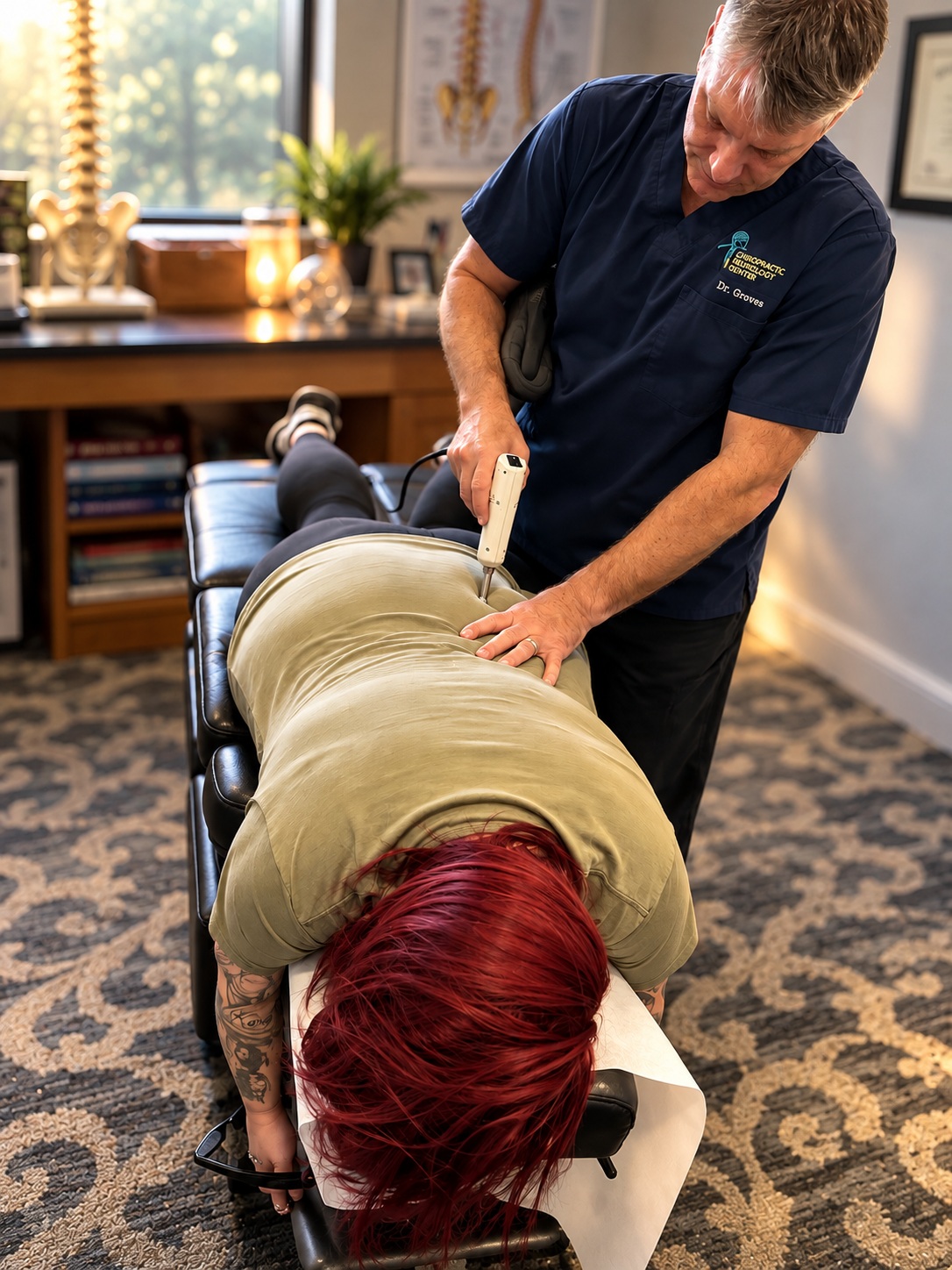
Chiropractic adjustments can be delivered by hand, with a handheld adjusting
instrument, or with a specialized drop table. At Chiropractic Neurology Center
in Long Beach, the doctor selects the approach based on the patient's history,
examination findings, comfort, and clinical needs. Instrument-assisted methods
can provide a quick, localized, lower-force impulse when a precise or gentler
adjustment is appropriate.
Decorative image representing chiropractic adjustment at Chiropractic Neurology Center.
Manual, instrument-assisted, and drop-table adjustment options
A manual chiropractic adjustment uses the doctor's hands to apply a controlled
force to a selected joint. Depending on the technique and area being treated,
the movement may be quick and brief or slower and more gradual.
Instrument-assisted adjustment uses a handheld mechanical or electronic device
to deliver a fast, controlled impulse to a small targeted area. Activator-style
instruments are a familiar example. The short, localized impulse can allow the
doctor to use less overall force and less joint positioning than some hands-on
techniques while maintaining precise control of the treatment location. This
approach can be used for all ages when clinically appropriate, with the technique
and amount of force selected for the individual patient.
A drop-table adjustment uses a chiropractic table with sections that release
a short distance as the doctor applies a directed force. This gravity-assisted
table movement works with the doctor's directed force to assist the adjustment
and can reduce the amount of force or body rotation needed for selected techniques.
During a manual adjustment, the chiropractor positions the patient and applies
a controlled force to a selected spinal or extremity joint. The specific
technique, amount of force, and positioning depend on the area being addressed
and the individual patient's examination.
Some manual techniques can produce a popping or cracking sound. That sound is
not required for every adjustment and is not, by itself, a measure of whether
the treatment was successful.
What is an instrument-assisted adjustment?
An instrument-assisted adjustment uses a handheld chiropractic adjusting device
to deliver a brief, targeted physical impulse. The Activator adjusting instrument
is one well-known example and traditionally uses a spring-loaded mechanical
mechanism. Other modern adjusting instruments may use cordless or electronic
mechanisms to create a similarly quick, controlled impulse.
Because the impulse is fast and localized, the doctor can target a specific area
with controlled force and often with less twisting, bending, or broad joint
positioning than some manual techniques. This can be useful when a patient prefers
a lower-impact experience or when the examination supports a lower-force, precise
approach. Instrument-assisted adjustments also commonly produce little or no
audible popping because the impulse is brief and localized.
Instrument-assisted care is not automatically appropriate for every person or
condition. The doctor considers health history, bone and joint health, examination
findings, comfort, and treatment goals before selecting a technique.
What is a drop-table adjustment?
A chiropractic drop table has one or more sections that can be raised slightly
and then release a short, controlled distance when the doctor applies a directed
force. The gravity-assisted movement of the table works with that directed force
to assist the adjustment and can allow the doctor to use a focused technique with
less overall force or body rotation in selected areas.
Drop-table techniques may be used by themselves or alongside manual and
instrument-assisted methods. As with every adjustment approach, the choice is
based on the individual examination and the doctor's clinical judgment.
How is the technique chosen?
There is not one adjustment technique that is best for every patient. The doctor
may consider factors such as:
Your health history and current symptoms
Physical and neurologic examination findings
The joint or body region being evaluated
Prior injuries, surgeries, or imaging findings
Bone health and other medical conditions
Your comfort and prior experience with chiropractic care
How you respond to treatment over time
The doctor may use more than one technique during a course of care or change the
approach as your condition and examination findings change.
What to expect during a visit
History and examination
The doctor reviews your symptoms, health history, medications, prior injuries,
and relevant imaging or medical reports. A physical and neurologic examination
may be performed as appropriate.
Technique selection
If an adjustment is appropriate, the doctor determines whether a manual,
instrument-assisted, drop-table, or another chiropractic technique fits the
clinical findings and your individual needs.
Adjustment
The selected joint or region is positioned and treated using the chosen
technique. Tell the doctor immediately about unexpected pain, numbness,
weakness, dizziness, visual symptoms, or another concerning change.
Response and next steps
Your response is considered along with the examination. Future care may include
additional adjustment, therapeutic exercise, another conservative approach,
additional testing, or referral when appropriate.
What might I notice afterward?
Some people experience temporary soreness, stiffness, headache, or tiredness after
a chiropractic adjustment. If symptoms are severe, unusual, worsening, or do not
resolve as expected, contact an appropriate healthcare professional.
Serious complications are uncommon, but no procedure is risk-free. The doctor should
know about important medical conditions and neurologic symptoms before deciding
whether an adjustment is appropriate.
When may an adjustment require additional medical review?
Tell the doctor about your complete health history, including severe osteoporosis,
recent fractures or major trauma, spinal cancer, significant numbness or weakness,
known spinal instability, prior spine surgery, vascular or stroke risk concerns,
and other serious medical conditions.
Depending on the history and examination, the doctor may recommend a lower-force
technique, a different treatment approach, imaging, medical evaluation, or referral
instead of an adjustment.
Common questions about manual, instrument, and drop-table adjustments
Is an instrument-assisted adjustment the same as a manual adjustment?
No. Both are chiropractic adjustment approaches, but a manual adjustment uses
the doctor's hands while an instrument-assisted adjustment uses a handheld device
to deliver a brief, localized impulse.
Is a lower-force instrument always better for older patients?
No single technique is automatically best based on age alone. Bone health,
medical history, examination findings, symptoms, comfort, and other factors
should be considered before choosing a technique.
Do I need to hear a pop for an adjustment to work?
No. Some manual adjustments produce an audible sound and others do not.
Instrument-assisted adjustments may also feel very different from manual care.
The sound itself is not the goal of treatment.
What does the drop section of the table do?
The section releases only a short distance as the doctor applies a directed
force. The table movement assists the technique, allowing the adjustment to be
performed with a controlled and focused input.
Can I ask for a particular adjustment technique?
Yes. Tell the doctor about your preferences, concerns, and previous experiences.
The final technique should also be appropriate for the clinical findings and
your health history.
Manual and instrument chiropractic adjustment in Long Beach
Chiropractic Neurology Center is located at
1225 E Wardlow Rd, Long Beach, CA 90807. If you have questions
about manual chiropractic adjustment, Activator-style or other instrument-assisted
care, drop-table techniques, or which approach may be appropriate for you,
contact the office.
Information only:
This page provides general educational information and is not a diagnosis, a guarantee
of outcome, or a substitute for individualized medical advice or emergency care.