X-ray imaging can provide useful information about bones, joints, and certain structural
changes. At Chiropractic Neurology Center in Long Beach, X-rays may be considered when
the history and examination indicate that imaging could help answer a clinical question
or influence the next step in care.
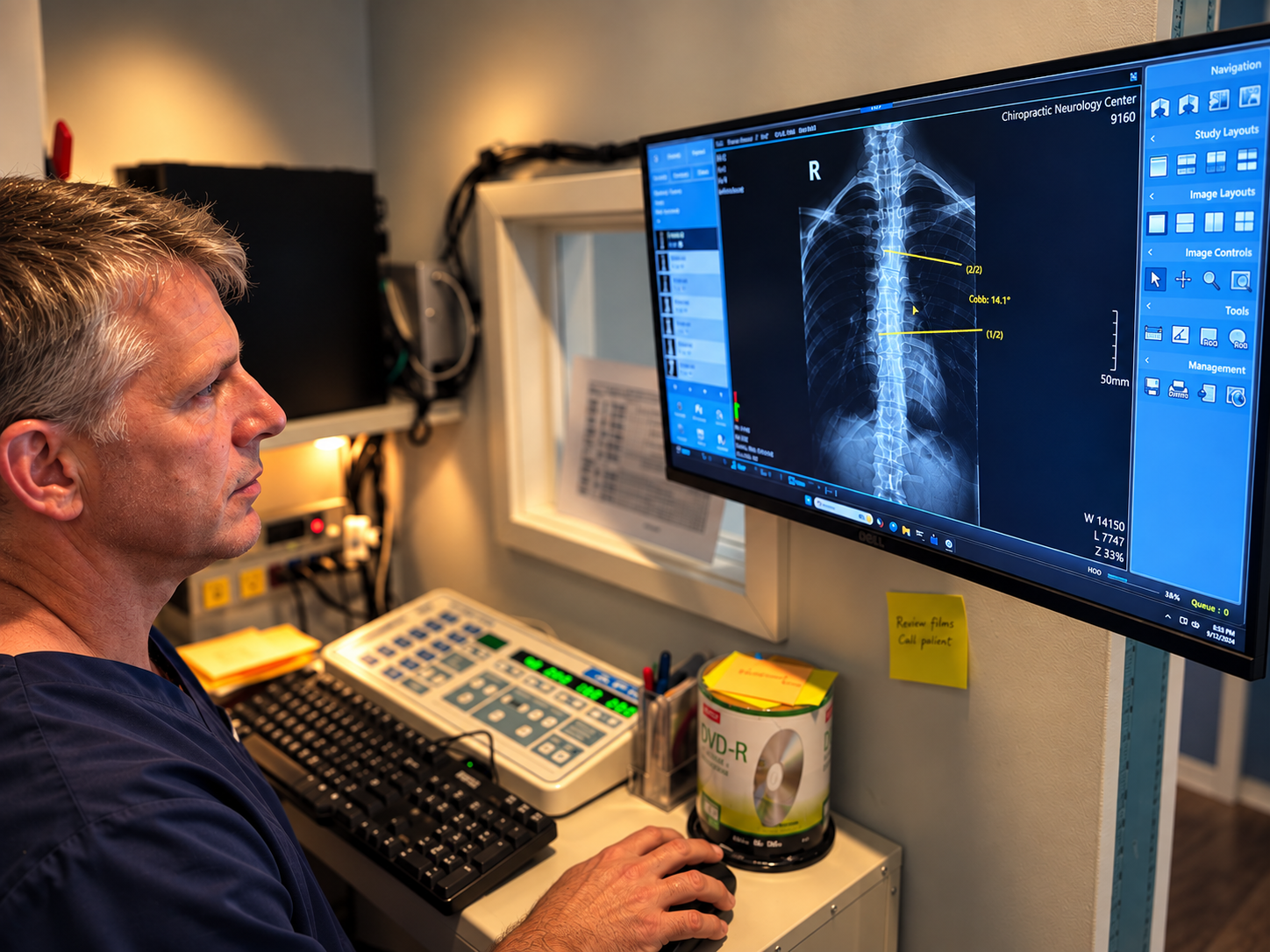
Dr. Shad Groves reviewing an X-ray image at Chiropractic Neurology Center.
What does an X-ray show?
X-rays use a small amount of ionizing radiation to create images in which bones
and other dense structures are especially visible. They can help identify or further
evaluate certain fractures, degenerative changes, joint findings, and other bony
conditions.
X-rays do not show every cause of pain or neurologic symptoms. Depending on the
clinical question, another type of imaging or medical evaluation may be more appropriate.
Whether imaging is appropriate depends on the patient's history, examination, age,
previous imaging, injury history, and the clinical question. Examples of situations
that may lead a doctor to consider X-ray imaging include:
Concern for a fracture or significant bony injury
Persistent symptoms where structural information may affect the plan
Known or suspected degenerative joint or spinal changes
Follow-up of a previously identified bony condition when appropriate
Situations where the examination suggests that imaging should be reviewed before certain treatment decisions
Not every new patient needs an X-ray. Avoiding unnecessary imaging is part of choosing
the right test for the right clinical question.
How CNC uses imaging information
An X-ray is interpreted in the context of the history and examination rather than in
isolation. If imaging is obtained or prior images are available, the doctor may use
that information to help decide whether conservative care is appropriate, whether a
technique should be modified, or whether additional evaluation or referral is needed.
If another imaging study or specialist review would better answer the clinical
question, the doctor may recommend that instead of, or in addition to, an X-ray.
X-ray equipment and positioning at CNC
When X-rays are clinically indicated, positioning and the views selected are based on the
clinical question being evaluated. The example below shows the X-ray equipment used in
the office and how a patient may be positioned for an image.
What to expect if X-rays are recommended
Clinical decision
The doctor explains why imaging is being considered and what question the
X-ray is intended to help answer.
Preparation and positioning
You may be asked to remove metal objects or clothing that interferes with the
image. Positioning depends on the body area and the views that are needed.
Image acquisition
You will be asked to remain still briefly while each image is obtained.
The number of views depends on the clinical question.
Review and next steps
The findings are considered together with your examination. If something
requires different imaging, medical evaluation, or specialist care, the doctor
can discuss the appropriate next step.
Before an X-ray
Tell the office if you are pregnant or think you could be pregnant.
Bring relevant prior X-ray, CT, MRI, or radiology reports when available.
Tell the doctor about recent major trauma, surgery, cancer history, infection, or other important medical conditions.
Ask questions if you do not understand why imaging is being recommended.
The goal is to obtain imaging only when the expected clinical information justifies
the examination and to avoid unnecessary repeat studies when prior information is
available and adequate.
Common questions about X-rays
Does every chiropractic patient need X-rays?
No. Imaging should be based on the history, examination, and whether the result is
likely to affect the clinical decision.
Can an X-ray show a disc or nerve problem?
X-rays are especially useful for bony structures. Some disc, nerve, spinal cord,
and other soft-tissue conditions may require different imaging or evaluation.
Should I bring old imaging?
Yes, when available. Prior images and radiology reports may provide useful history
and can sometimes reduce unnecessary repeat imaging.
What if I may be pregnant?
Tell the doctor and imaging staff before any X-ray is taken so the clinical need
and appropriate imaging approach can be reviewed.
Chiropractic X-ray evaluation in Long Beach
Chiropractic Neurology Center is located at
1225 E Wardlow Rd, Long Beach, CA 90807. If you have questions about
prior imaging, whether to bring an X-ray or MRI report, or whether imaging may be
considered during your evaluation, contact the office.
Information only:
This page provides general educational information and is not a diagnosis, a guarantee
of outcome, or a substitute for individualized medical advice or emergency care.