Coordination and balance activities are individualized movement tasks used to challenge
how the brain and body organize visual, vestibular, sensory, and motor information.
At Chiropractic Neurology Center in Long Beach, these activities may be selected after
an appropriate neurologic and physical evaluation.
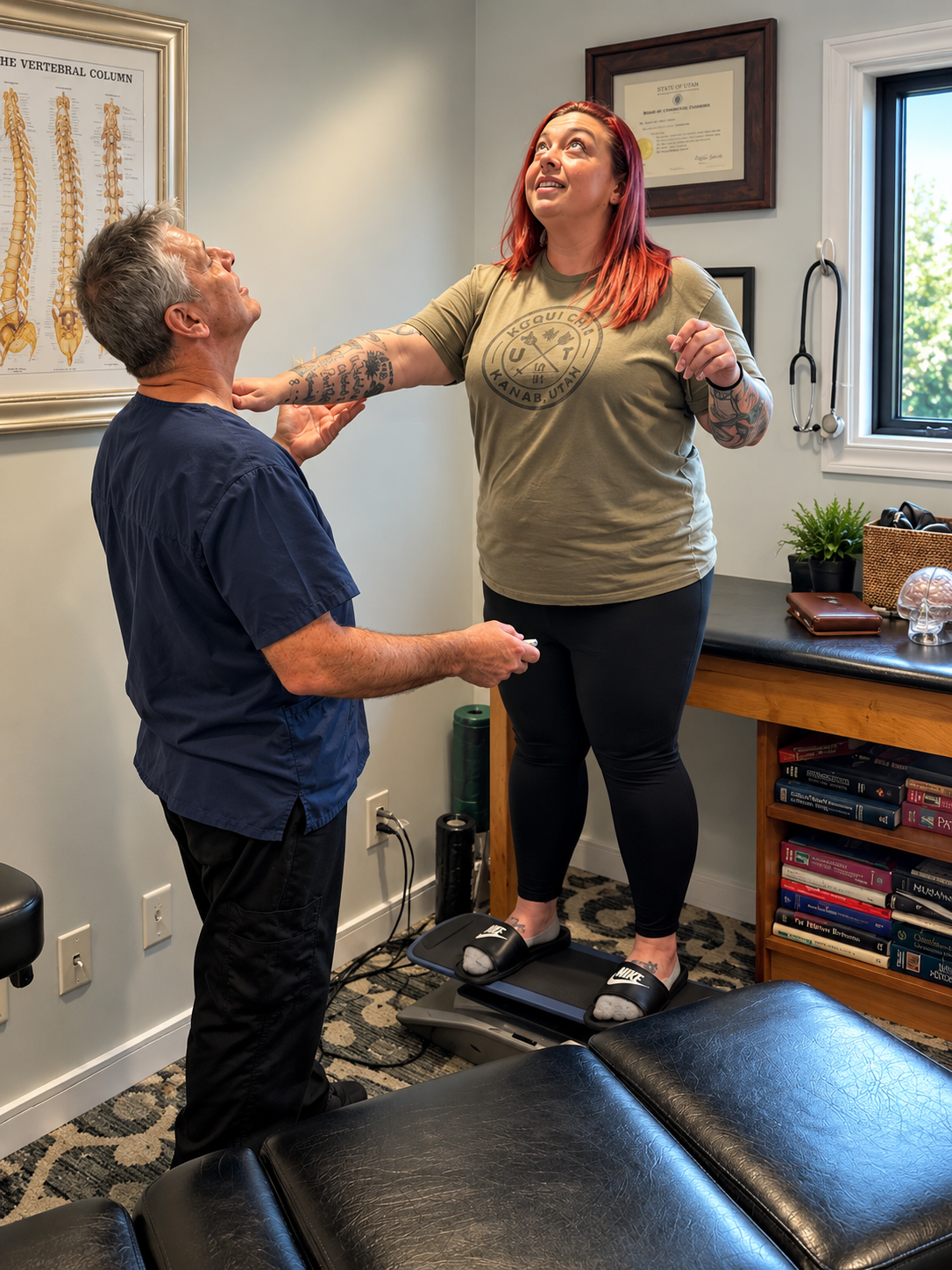
Dr. Shad Groves supervising a patient during a balance activity at Chiropractic Neurology Center.
Why coordination and balance matter
Standing and moving safely require several systems to work together. Vision provides
information about the environment, the vestibular system helps detect head movement
and position, and sensory information from muscles and joints helps the brain estimate
where the body is in space.
Coordination also depends on timing, accuracy, strength, attention, and the ability to
adjust movement when conditions change. An individualized activity can challenge one
or more of these components in a controlled way.
What might coordination and balance activities include?
The exact activities depend on the evaluation and may involve tasks such as:
Changing stance or base of support
Controlled head or eye movements during a task
Stepping, reaching, or directional movement
Hand-eye or foot-eye coordination activities
Tasks performed with changing visual or sensory information
Progressive movement challenges selected for the individual's ability and safety
Not every activity is appropriate for every patient. A challenge that is useful for
one person may be unsafe, too difficult, or irrelevant for someone else.
How CNC selects balance and coordination activities
The doctor may consider neurologic findings, balance testing, eye movements,
coordination, gait, strength, sensation, musculoskeletal findings, fall history,
and the patient's goals before selecting an activity.
The level of challenge can be adjusted by changing the position, speed, duration,
visual input, support surface, or complexity of the movement. The goal is to choose a
task that is meaningful and appropriately challenging without creating unnecessary risk.
What to expect
Evaluation of balance and coordination
The doctor may assess standing balance, walking, eye movements, limb
coordination, sensory responses, and other neurologic or musculoskeletal
findings as appropriate.
Selection of a safe starting level
An activity is selected based on your current ability. Support, supervision,
or a simpler version may be used when fall risk or symptom provocation is a concern.
Practice and observation
The doctor or staff may observe accuracy, stability, speed, symptom response,
and whether you need assistance while completing the task.
Progression or modification
The activity may become more complex, remain at the same level, or be changed
depending on your response and the clinical goal.
Balance activities and home safety
Some balance activities are not appropriate to practice alone. If you are given a
home exercise, follow the instructions about support surfaces, nearby stable objects,
footwear, supervision, and when to stop.
If you normally use a cane, walker, glasses, hearing aids, or another assistive device,
bring it to your appointment unless the office gives you different instructions.
Common questions about coordination and balance activities
Are balance activities the same as vestibular testing?
No. Vestibular testing is used to gather information about balance-related
function, while coordination and balance activities are movement tasks selected
as part of care when appropriate.
Will the activities make me dizzy?
Some activities can temporarily provoke dizziness, visual motion sensitivity,
or unsteadiness. The level of challenge should be selected for the individual,
and unexpected or severe symptoms should be reported.
Do I need to already have poor balance to use these activities?
Not necessarily. Coordination and balance tasks can be selected for different
functional goals. The decision depends on the evaluation rather than on a single symptom.
Can I practice these activities at home?
Only when the activity is appropriate for home use and you have been given clear
safety instructions. Activities with meaningful fall risk may require supervision
or a different setup.
Coordination and balance activities in Long Beach
Chiropractic Neurology Center is located at
1225 E Wardlow Rd, Long Beach, CA 90807. Contact the office if you
have questions about balance, coordination, vestibular evaluation, or whether an
appointment is appropriate.
Information only:
This page provides general educational information and is not a diagnosis, a guarantee
of outcome, or a substitute for individualized medical advice or emergency care.